Tap a day on the poster to check it off — your progress is saved on this device.


Core Control is a month of standing work for the muscles that rotate your trunk and stabilise your hips. Torso twists work your obliques and the deep muscles around your spine. Side leg raises work the outer hips and glutes on the lifting side while the standing leg and your core keep you upright and level. Neither involves the floor, equipment, impact or noise, and both can be done sitting down. This is one of the gentlest challenges we have and it is difficulty 1 for that reason. What it trains is control - the ability to keep your trunk still while a limb moves and to rotate through your middle rather than your arms - along with endurance in muscles most training skips. It will not build power or visible abs.
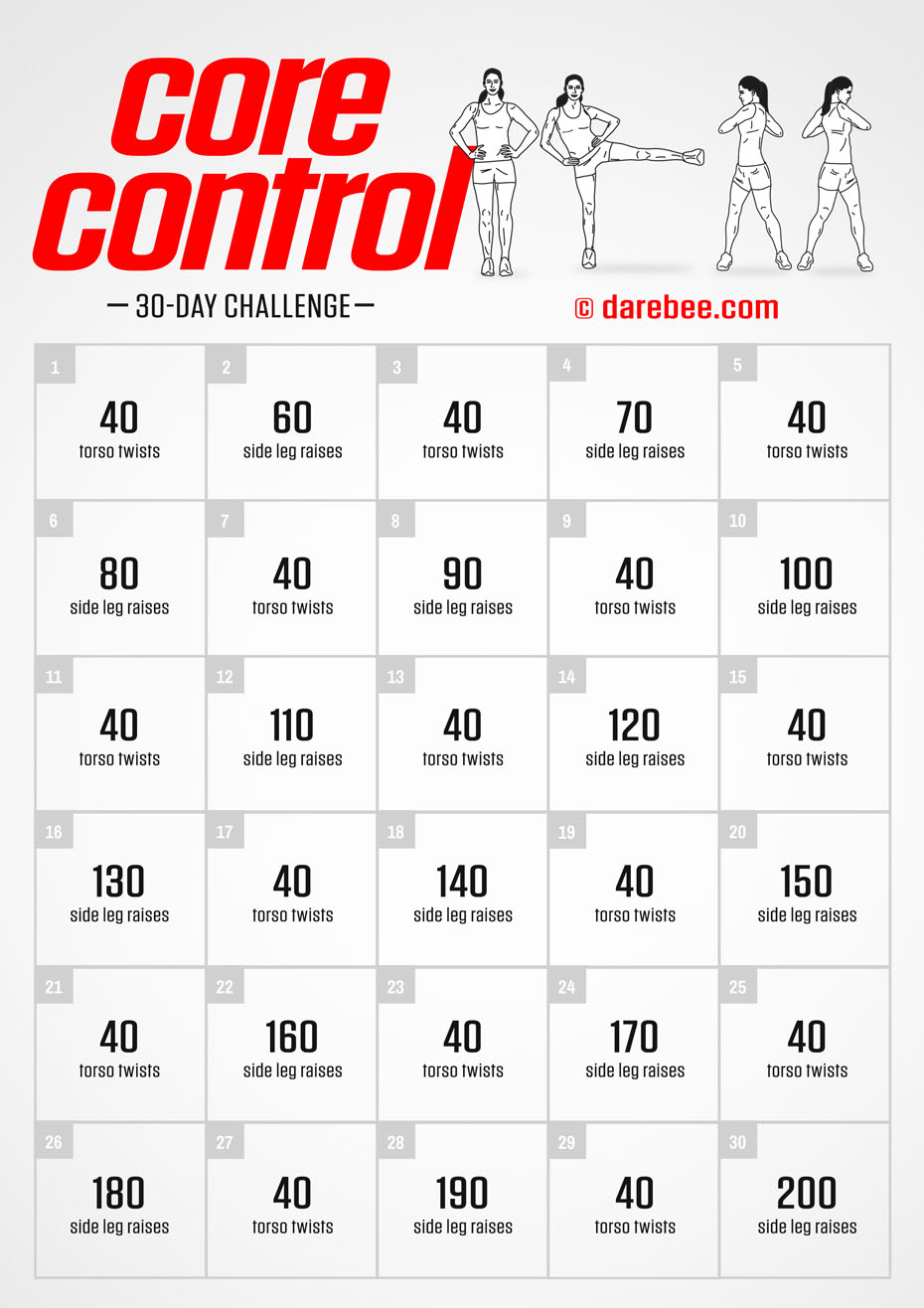
The calendar does something unusual. The torso twists never change: 40 on every odd day, from day 1 to day 29, so the same dose fifteen times. The side leg raises climb by 10 every even day without a single pause, from 60 on day 2 to 200 on day 30. One exercise is a fixed daily habit and the other is a straight line up. There are no sets on the poster, so each day's number is a total you can split however you like, and on leg raise days the total covers both legs. The last week is 170 to 200 leg raises a day, which is a lot of time standing on one leg, and that is where the challenge stops being trivial.
How to do the exercises
Two exercises run through this challenge: torso twists and side leg raises.
- Torso Twists: stand with your feet shoulder-width apart, knees soft, and bring your hands up in front of your chest with your elbows out. Rotate your upper body as far as it comfortably goes to one side, then to the other. Each turn counts as one. Keep your hips facing forward and your feet planted so the rotation happens through your waist rather than your legs, and keep the movement smooth rather than flinging your arms to add range. Your head turns with your shoulders. If standing is a problem, sitting twists work the same muscles from a chair. Side bends are a change of direction if you want to vary the odd days.
- Side Leg Raises: stand tall with your hands on your hips or one hand on a wall or chair for balance. Keeping your body upright and your toes pointing forward, lift one leg straight out to the side as high as you can without leaning away from it, then lower with control. Each raise counts as one. Do half the day's number on each leg. Height matters less than staying upright - the moment your torso tips to the other side, the work moves from your hip to your lower back and the rep stops counting for anything. Keep your standing knee soft. If you cannot stand for the count, the floor version lying on your side works the same muscles, and a seated version with the leg extended out to the side from a chair edge is a fair substitute.
Adjust Difficulty
Make it easier: Split the total into manageable sets with a short rest between them, or spread the leg raises across the day in blocks of 20 per leg. Hold a wall or the back of a chair throughout so balance is not the limiting factor. Shorten the range on the leg raises and slow the twists down. Do both exercises seated on the days standing is not possible. A reduced day keeps the streak.
Make it harder: Take your hands off the wall and do the leg raises with your hands on your hips or behind your head. Pause for a 2-count at the top of every raise and lower for a 3-count. Do the day's total on one leg before switching rather than alternating. On twist days, hold a bottle of water in each hand or slow each twist to a 3-count with a pause at the end of the range. Doing the leg raises standing on a folded towel or a cushion makes the standing leg and your core work considerably harder.
What to expect
The first week feels like a warm-up, which it is. Forty twists take about a minute and 60 to 80 leg raises split across two legs barely register. Expect the outer hips to be a little sore after the first few even days if this is a new movement, and expect your balance to be the thing that fails before your muscles do. By week two the leg raise numbers pass 100 and the standing leg starts to tire before the lifting one, which is the challenge doing its job. The twists stay comfortable all month because the number never moves, and by the end they are a quick daily reset rather than work. Weeks three and four are 150 to 200 leg raises a day, and the last few will feel heavy in the hip and shaky in the standing leg. What you get is better balance on one leg, hips that feel more stable when you walk and climb stairs, and obliques that switch on when you turn. What you do not get is a stronger core in the lifting sense or any change to how your midsection looks. For that you need load, and this is the place to start before adding it.