
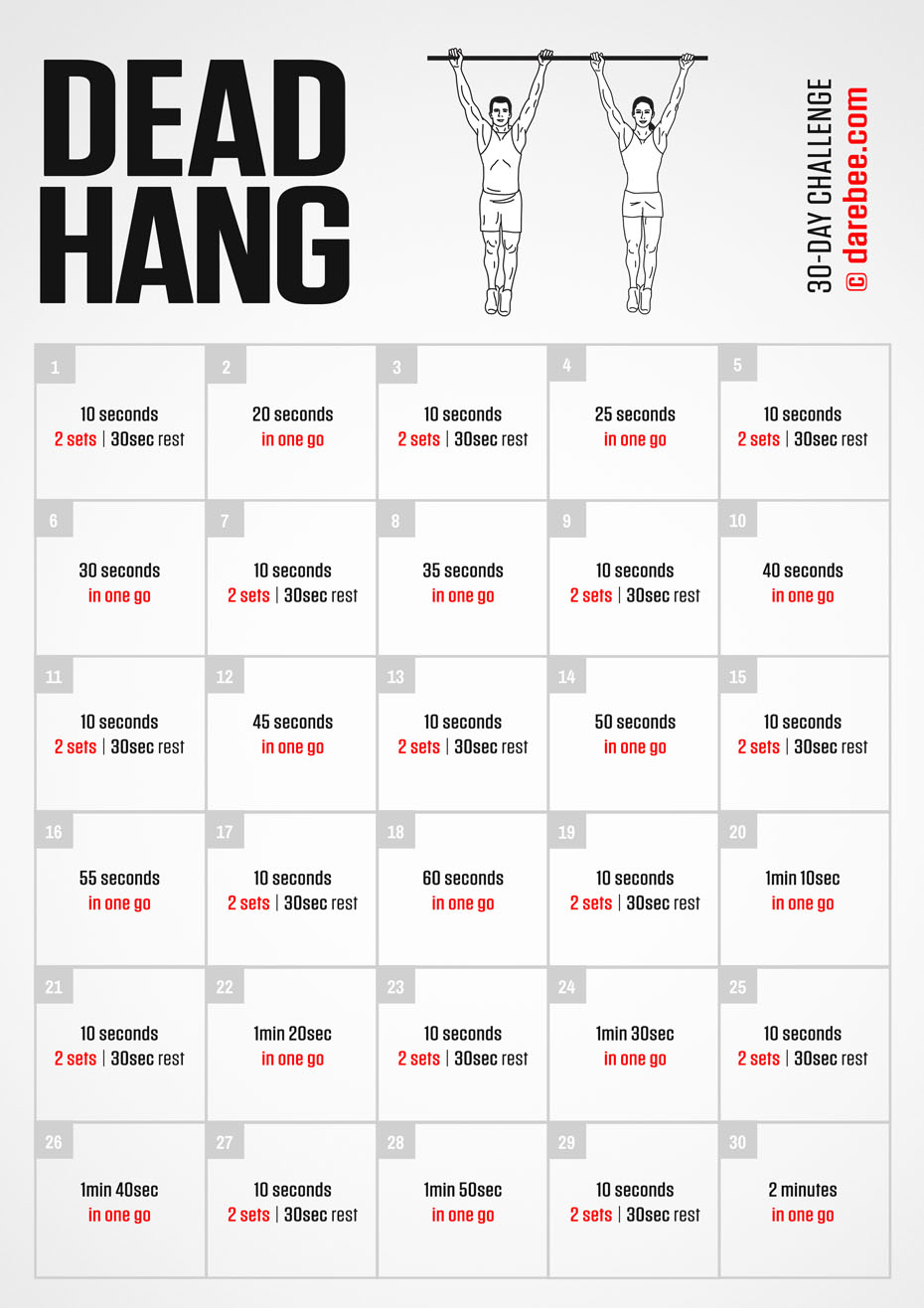
Tap a day on the poster to check it off — your progress is saved on this device.


A dead hang is exactly what it sounds like: you take hold of a bar, lift your feet and hang there. Nothing moves. What works is your grip and forearms, which carry your entire bodyweight through your fingers, and the muscles around your shoulder blades that keep your shoulders from riding up around your ears. Your spine and shoulders get a stretch that nothing else gives them. This challenge needs a bar - a doorway pull-up bar, a playground bar or a beam that will take your full weight - and there is no version of it without one. No floor, no impact, no noise. The difficulty rating is 3 because hanging looks like resting and is not. Most people's grip gives out well before a minute on day 1.
The calendar splits into a fixed day and a climbing day. Odd days never change: 10 seconds, 2 sets, 30 seconds of rest, on every odd day from 1 to 29. That is the maintenance dose and it keeps your grip and your elbow tendons adapting without ever wearing them out. Even days are a single unbroken hang and they climb every session. Up to day 18 they rise by 5 seconds at a time, from 20 seconds to a full minute. After that the step doubles: 1:10, 1:20, 1:30, 1:40, 1:50 and 2 minutes on day 30. The first half of the month gets you to a one-minute hang and the second half doubles it. If your grip fails before the time is up, let go, re-grip straight away and make up the seconds you missed - the hang is the total for the day, not a single unbroken effort until you can make it one.
How to do the exercises
This challenge uses one exercise for the whole month: the dead hang.
Grip the bar with your palms facing away from you and your hands about shoulder-width apart, thumbs wrapped round rather than resting on top. Lift your feet and hang with your arms straight. Pull your shoulder blades down a little so your shoulders are not jammed up against your ears - this is an active hang and it is easier on the joints than letting everything go slack. Keep your body still rather than swinging and breathe normally, since gripping hard makes most people hold their breath. Let go and lower yourself to the floor rather than dropping. A palms-facing grip is allowed and most people find it slightly easier. When your grip starts to fail, hang on for the extra second or two and then let go, re-grip immediately and continue. How To Improve Grip Strength covers why the forearm work here transfers to almost everything else you do with your hands.
Adjust Difficulty
Make it easier: Keep a chair or step under you and rest a toe on it to take some of your weight, using less as the month goes on. Split the even day's time into as many hangs as you need with a shake-out between them. Chalk or a towel over the bar helps if your hands slip. Take 60 seconds between the odd day sets. If you have no bar at all, the grip half of the challenge can be trained by holding two heavy bags at your sides for the calendar time, or by hanging a towel over a sturdy door top and gripping it with your feet still on the floor. Neither gives your shoulders the stretch a real hang does, but they keep your grip working and the month alive.
Make it harder: Hang from a towel draped over the bar instead of the bar itself. Use one hand for the odd day sets, 10 seconds each side. Add a 5-second scapular pull at the end of every hang - shoulders down and back, arms straight. Once 2 minutes is comfortable, the Pull-Ups Guide is where this leads and the hang time you have built is the foundation for it.
What to expect
The first week will make your forearms burn in a way you have probably not felt before and your hands may be tender the next morning. Expect the 20 to 30 second hangs on the early even days to feel much longer than they are and expect to re-grip at least once. The 10-second days will feel easy from the start, which is their job. Your elbows and the insides of your forearms are the thing to watch - daily hanging loads tendons that adapt slowly, so a dull ache there in the second week is your cue to keep the odd days light and to lower yourself gently rather than dropping off the bar. Training Smart: Tendons, Ligaments and Fascia explains why. By week three the minute hang is real and your shoulders will feel looser after each session rather than tired. The last week is 1:40 to 2 minutes and holding that long is a grip most people never build. What you get is a much stronger grip, steadier shoulders and a stretch through your spine that you will miss if you stop. What you do not get is abs or a different-looking body - a hang is a hang. By day 30 you will hold a bar for 2 minutes, and that is the number that makes everything else you pull possible.